
What's the situation?
A single male Oriental fruit fly was found in a surveillance trap in Papatoetoe, Auckland, on 25 February 2026. Biosecurity New Zealand has responded swiftly, ramping up trapping and inspection.
A significant number of additional fruit fly lure traps are being set within a 1,500 metre area of the original find to determine if other flies are present.
A Controlled Area Notice is in place, restricting the movement of fruit and vegetables in the area.
Why we don't want Oriental fruit flies in New Zealand
If they established here, Oriental fruit flies could have serious consequences for New Zealand’s horticultural industry. They can damage a wide range of fruit and vegetables and it could lead to restrictions affecting our horticultural exports.
Controlled Area Notice (CAN) is in force
The Auckland suburb of Papatoetoe is under a CAN, effective from 26 February 2026. This restricts the movement of certain whole fruits and vegetables out of the controlled area to help prevent the spread of fruit flies, if there are more out there.
Controlled Area Notice: Oriental fruit fly in Papatoetoe, 2026 [PDF, 687 KB]
These legal controls are an important precaution while we investigate whether there are further fruit flies in the area. Should there be any more flies out there, this will help prevent their spread.
This area is divided into two zones – A and B. Each zone has different restrictions.
- Zone A is a 200-metre area, including 501 properties.
- Zone B covers a 1,500-metre area, including 9,481 properties.
Check our map or the CAN to see if you are in the controlled area and which zone applies to you.
Signs will be put in place notifying people of the restrictions and marking the controlled area boundaries.
Map
Controlled Area Notice zones
If you live in Zone A
No whole fruits and vegetables (other than leafy or soil-free root vegetables and cooked, processed, preserved, dried, frozen and canned fruits) can be moved from Zone A of the controlled area.
Compost and green waste from gardens also cannot be moved out of this zone.
Residents in Zone A are asked to avoid composting fruit and vegetables. Separate fruit and vegetable waste from the rest of your household rubbish and dispose of it using a sink waste disposal unit if you have one or put it in the bins to be provided by Biosecurity New Zealand. Bins will be delivered soon, and residents will be advised of their locations. Your general rubbish can go out with your normal rubbish collection.
Leave any homegrown fruit or vegetables that have fallen from trees or plants (windfall) on the ground in your garden. Biosecurity New Zealand inspectors may collect this material to check it for the presence of fruit fly. Waste from homegrown fruit and vegetables that have already been chopped up and is free of any bugs can be disposed of in a Biosecurity New Zealand bin. If you find eggs or larvae in home-grown produce, tie all the fruit or vegetable material inside a plastic bag and call Biosecurity New Zealand on 0800 80 99 66.
If you live in Zone B
No fruit and vegetables grown in Zone B can be moved out of the controlled area. You are free to move commercially purchased fruit and vegetables (for example, fruit and vegetables bought at the supermarket) out of the area.
Homegrown produce waste and garden waste need to be disposed of in Biosecurity New Zealand bins.
If in doubt, don't take it out.
Information for people in the controlled area making packed lunches
If you live in the area and you're preparing lunch for work or school, you can still include fruit and vegetables. Just make sure it's cut up and you can’t see any larvae in it.
About the Oriental fruit fly
The Oriental fruit fly is widespread in Africa and Asia. In Oceania, it is present in Christmas Island, Papua New Guinea, Palau, Hawaii, and Tahiti. However, it is not in Australia.
It can affect over 300 hosts, including apples, kiwifruit, citrus, and tomatoes. Adult flies lay eggs in fruit. The young stages (maggots) feed inside the fruit, causing it to rot and become unmarketable.
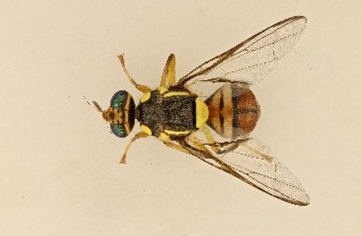
Adult flies:
- are a little larger than a housefly (6 mm to 8 mm long)
- have a dark "T" shaped marking on the abdomen (the part behind the waist)
- usually have a bright yellow and orange abdomen (but can vary)
- have clear wings.
The thorax (behind the head) is dark or near black with 2 near-parallel thin yellow strips running down each side of the thorax.
The female fly has a pointed "sting" to lay eggs inside fruit (but she can't sting or bite people).
Larvae look like white long-grain rice.
Find out more about Oriental fruit flies

Image files
Oriental fruit fly on a fruit [JPG, 354 KB]
Oriental fruit fly dorsal [JPG, 175 KB]
Oriental fruit fly lateral [JPG, 112 KB]
You can help keep fruit flies out by being vigilant
It requires a big effort from all New Zealanders to keep fruit flies out.
If you think you’ve found this fruit fly or seen what look like its maggots in fruit:
- photograph it
- capture it (if you can)
- call 0800 809 966
Resources
Fact sheet: Oriental fruit fly – what you need to know [PDF, 281 KB]