

Why exotic caulerpa is a risk to NZ
There are 2 almost identical species of exotic caulerpa known to be in New Zealand waters – Caulerpa brachypus and Caulerpa parvifolia. Together we refer to them as exotic caulerpa.
These 2 pest seaweeds can spread rapidly, sometimes forming large underwater fields. Exotic caulerpa can compete with other species for space and upset the balance of local ecosystems.

The extent of exotic caulerpa varies depending on multiple factors, including water temperatures and salinity, water movement, and seabed composition (for example, if it's sandy and silty or rocky). In the 5 years exotic caulerpa has been present in New Zealand waters, its density has ranged from thick carpets in some areas to sparsely distributed plants in others. There was a major reduction event in late winter 2025 where exotic caulerpa all but disappeared, but this was followed by some regrowth and some new areas of infestation over the summer of 2025–26. As of April 2025, there are still no known continuous multi-hectare mats of caulerpa as previously seen.
Where exotic caulerpa has been found
Exotic caulerpa was first found in New Zealand in July 2021 at Aotea Great Barrier Island in Hauraki Gulf. It has since been confirmed at multiple locations around the Hauraki Gulf, at Coromandel and in Northland.
It is not known where or when exotic caulerpa first entered New Zealand waters. It is considered likely it arrived on a vessel travelling from Australia or the Pacific. The amount found in the various locations suggests it had been here for several years before it was first discovered at Aotea.
Current map of known exotic caulerpa locations
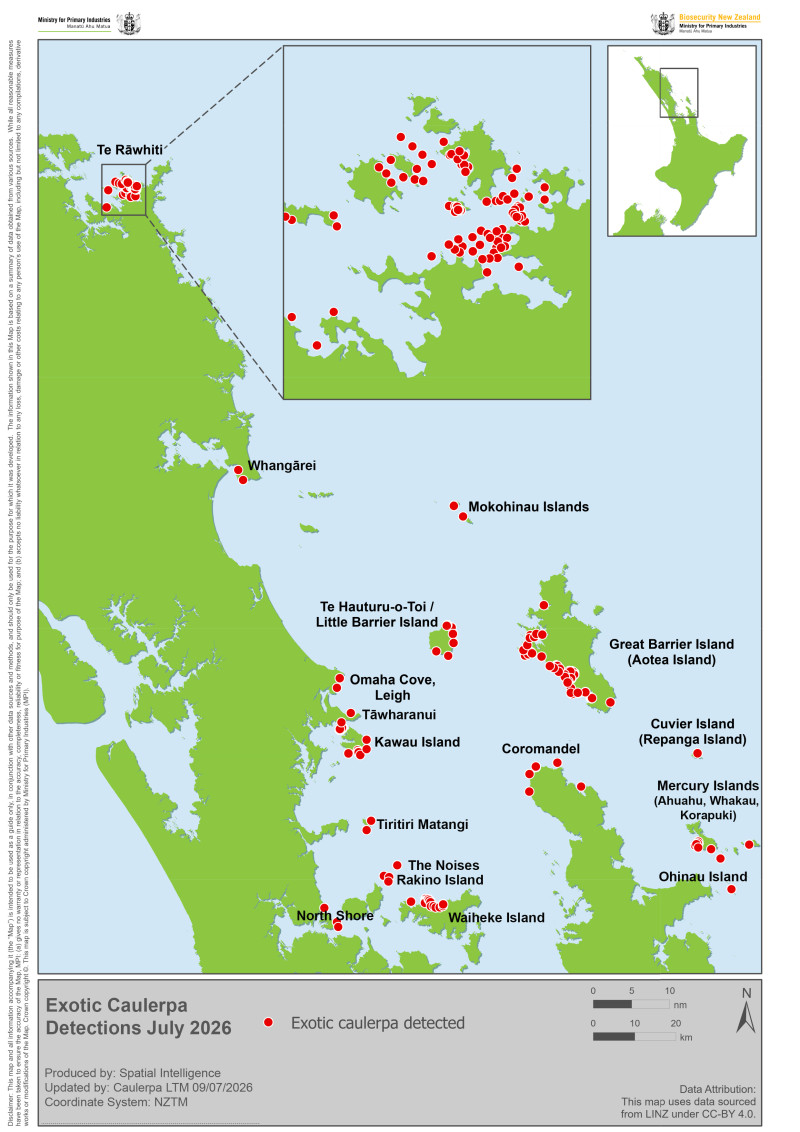
Download a larger, printer-friendly version [PDF, 1.9 MB]
Interactive map
An interactive map with the most recent known exotic caulerpa locations is available at the Marine Pests New Zealand website. It's for anyone interested in knowing where surveillance has occurred and whether exotic caulerpa is present or absent.
Community exotic caulerpa viewer – Marine Pests New Zealand
The work being done on exotic caulerpa
Since its discovery in 2021, Biosecurity New Zealand has been working closely with partners, including mana whenua at affected places, local councils, and communities, to try to slow its spread and find or develop potential ways to manage it.
Over $31 million has been spent or allocated to scientific research to understand the pest, surveillance to find it, development and testing of techniques to remove or minimise it, and communications and legal controls to prevent its spread.
While the complete and permanent removal of caulerpa from New Zealand is not feasible with the current tools and the scale of the infestation here, there has been significant work carried out to find ways to suppress it (that is, to reduce density to lower the risk of spread) or remove it from specific sites.
Find out about the programme to develop new surveillance and treatment technologies
Exotic Caulerpa National Steering Group
The steering group's role is to oversee the long-term management of exotic caulerpa in New Zealand and to guide progress according to the national strategy.
Exotic caulerpa national strategy (2025) [PDF, 15 MB]
As well as providing strategic oversight, the group is overseeing the development of an operational plan and its delivery, reviewing the strategy when required, and championing the strategy within their respective networks.
The 7-member group, which met in March 2026 for the first time, includes representatives for mana whenua, central and local government, science providers and community and environmental groups.
Members are:
- Andrew Harrison – Independent Chair
- Samantha (Sam) Hill – Auckland Council
- Kirstie Knowles – Te Papa Atawhai Department of Conservation (DOC)
- Martin Cleave (Te Rarawa, Ngātiwai) - Tangata Whenua
- Dr Graeme Inglis – Earth Sciences New Zealand (formerly NIWA)
- Nyree (Nyze) Manuel – Tangata Whenua/Northland Conservation Board
- John Walsh, Director Pest Management, Biosecurity New Zealand
Exotic caulerpa annual report 2024–2025
This report captures the work carried out over the 2024–2025 financial year on the management of exotic caulerpa.
It reports on the long-term management approach, including work on research, treatment tools and education. It covers the significant natural biomass reduction that has occurred as well as research findings on the impacts of exotic caulerpa on local marine ecosystems.
Detail is included on work in 5 workstreams (as set out in the Exotic Caulerpa National Strategy): prevention, detection and monitoring, removal, research, and coordination and delivery.
Exotic caulerpa annual report 2024–2025 [PDF, 8 MB]
Help stop the spread
Everyone working in or enjoying our coastal waters can help stop the spread.
If you operate a vessel, go diving or fishing, or you're out on the water, you should always check your anchor and gear for seaweed before you move to a new location. If you find any seaweed, bag it and put it in the rubbish on shore.
How to stop the spread of exotic caulerpa
You can also help by following the legal restrictions on anchoring and fishing that are in place at 4 of the areas with exotic caulerpa – Aotea Great Barrier Island, Ahuahu Great Mercury Island, Waiheke Island, and Te Rāwhiti Inlet, Northland.
Find out about the exotic caulerpa legal rules in force
Tell us if you find any exotic caulerpa
Keep an eye out for exotic caulerpa species and report suspected sightings to us. Take a photo, if possible, and note the location. Then either:
- freephone 0800 809 966
- or complete the online form at report.mpi.govt.nz