

Actions we've taken
New Zealand Food Safety has:
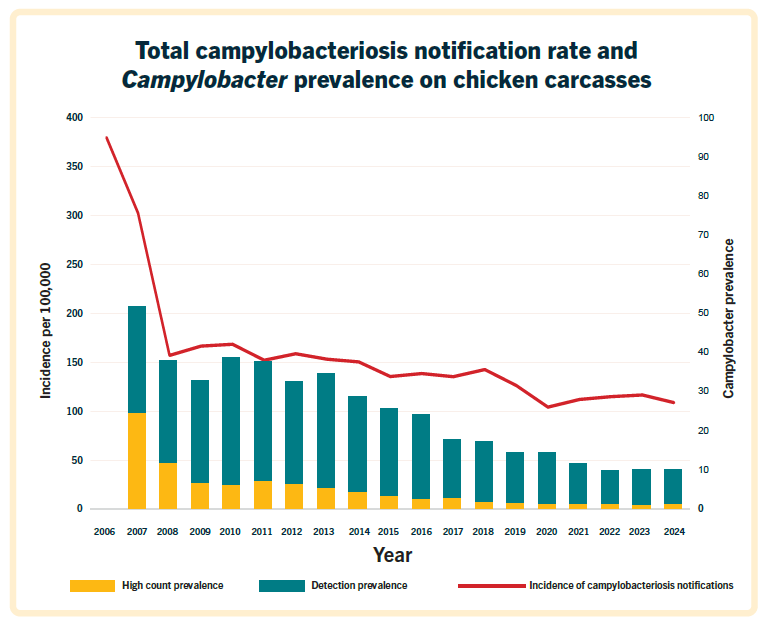
- facilitated the reduction of the incidence of campylobacteriosis by more than 70% between 2006 to 2024
- established a national programme to monitor Campylobacter levels on chicken carcasses and put performance targets in place that must be met by chicken processors. In 2007, 52% of samples were positive for Campylobacter, following process improvements taken by the poultry industry, this has reduced to 10% in 2024.
- undertaken scientific research on new analytical methods that may allow more precise monitoring of Campylobacter in chicken.
- undertaken a national retail survey to better understand Campylobacter rates in poultry products available to consumers
- provided significant input into the review and update of international guidelines for control of Campylobacter in chicken meat. These guidelines were originally developed by New Zealand in 2011.
- established a Campylobacter Governance Group with representatives from the Ministry of Health as well as organisations across the poultry meat food chain.
- continued to work with health authorities to improve surveillance of foodborne diseases
- continued to educate food service operators and consumers about safe handling and cooking of raw chicken
- begun developing a new strategy and action plan for 2026 to 2030.
- set a new goal to aim to further reduce the incidence of foodborne campylobacteriosis by 15 percent over the period 2025 to 2030, lowering the rate from 76 to 65 cases per 100,000 population.
- started developing a comprehensive work programme to help achieve this new target, with first steps to expand the Campylobacter Governance group membership to include representation from the foodservice sector.
Our strategy is helping reduce rates of Campylobacter
New Zealand Food Safety has a strategy and work plan to manage the risk of foodborne campylobacteriosis in New Zealand.
Our 'Campylobacter action plan' mainly focuses on the poultry food chain. It uses a risk-based, farm-to-plate approach. The approach identifies, selects, and implements new control measures. These measures help to reduce the rate of campylobacteriosis in New Zealand.
Campylobacter action plan 2025–2030 [PDF, 217 KB]
A governance group oversees the action plan and meets regularly to review progress and discuss issues.
November 2024 meeting minutes of the governance group [PDF, 375 KB]
August 2024 meeting minutes of the governance group [PDF, 399 KB]
April 2024 meeting minutes of the governance group [PDF, 388 KB]
November 2023 meeting minutes of the governance group [PDF, 385 KB]
Research helps us to control Campylobacter
To prioritise our work on Campylobacter, we need to understand the importance of different sources of Campylobacter and the ways people get infected.
To do this, we've done extensive research on the poultry, meat, and milk related food supply chains.
Setting regulatory limits for chilled poultry carcasses
In 2008, we introduced the Campylobacter performance target (CPT). It measured Campylobacter levels in processed chicken to check how effectively our measures reduced levels. We will continue to sample Campylobacter to make sure processors are producing food within acceptable limits. Samples are taken through our National Microbiological Database (NMD).
National Microbiological Database programme for meat
Source assigned campylobacteriosis in New Zealand study
Campylobacter case control study summary – SACNZS
Source assigned campylobacteriosis in New Zealand study (SACNZS) [PDF, 5.4 MB]
Collaboration with Consumer NZ
Are frozen, crumbed chicken products safe to eat? – Consumer NZ
Retail survey to better understand Campylobacter rates in poultry products
Survey of Product Contamination with Campylobacter at Retail [PDF, 882 KB]
International influence
International food safety standards are coordinated through the Codex Alimentarius Commission. New Zealand and Sweden co-led Codex work to develop the international guidelines for control of Campylobacter and Salmonella in chicken meat.
Guidelines for control of Campylobacter and Salmonella in chicken meat
In 2014, we prepared guidance for best hygienic practice in poultry processing. This was published internationally for other countries to adapt and use.
Campylobacter symptoms and advice
Related information
Foodborne disease annual reports
Safe cooking of livers: information for chefs
Who to contact
If you have questions about our Campylobacter research or our risk management strategy, email info@mpi.govt.nz